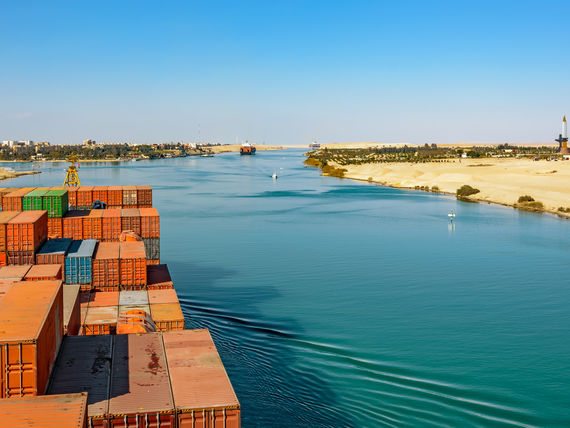
Houthi rebels based out of Yemen are threatening to resume attacks on commercial shipping in the Red Sea region, as tensions continue to escalate between the U.S. and Iran.
According to the Associated Press, Houthi rebels released footage on January 26, depicting an attack from a year prior in the Gulf of Aden against a Marshall Islands-flagged tanker. Included in the video was the caption, "Soon," implying that the Iranian-backed group is once again planning to target vessels moving through the region. This comes as a U.S. aircraft carrier and several other missile destroyers have made their way toward the region, "just in case" the U.S. decides to move against Iran, President Donald Trump told reporters on January 22. Trump had previously threatened to take action in the event that Iran kills peaceful protesters, or conducts mass executions of those arrested at recent demonstrations.
The Trump administration said on Monday it is restructuring the Federal Aviation Administration and will create a new safety oversight office to consolidate functions across five different units.
The move comes a day before the National Transportation Safety Board on Tuesday is set to criticize the FAA's failure to act on near-miss incidents at a hearing to determine the probable cause of the January 2025 collision between an Army helicopter and American Airlines passenger jet that killed 67 people near Reagan Washington National Airport.
The European Parliament has put off until next week a decision on whether to resume work on the EU's trade deal with the United States, which it had suspended in protest at President Donald Trump's demands to acquire Greenland and threats of tariffs.
The parliament's trade committee had been due to set its position in votes on Monday and Tuesday, and the assembly's president, Roberta Metsola, said last week discussions could resume soon to get the process back on track.
India and the European Union reached a free trade agreement to deepen economic and strategic ties, officials said Tuesday, after nearly two decades of negotiations.
The accord, which the head of the EU’s executive branch described as the “mother of all deals,” could affect as many as 2 billion people. It will likely take several months before the agreement takes effect.
Canadian Prime Minister Mark Carney says that he is not pursuing a free trade deal with China, following tariff threats from President Donald Trump over Canada's bid to lower certain levies against China.
Canada and China reached a preliminary trade deal on January 16, with Canada agreeing to cut tariffs on 49,000 Chinese EVs from 100% to 6.1%, and China slashing duties on Canadian agricultural products from 85% to 15%. After initially expressing support for the agreement shortly after it was announced, Trump accused Carney days later of allowing China to use Canada as a "drop-off port" for Chinese goods, and threatened to hit Canada with 100% tariffs on all goods.
The Federal Maritime Commission has opened a formal investigation into whether ocean carriers are unlawfully restricting truckers and shippers from choosing their own chassis providers, focusing on potential violations of federal shipping law.
Announced Sunday, the probe will examine whether carriers are using association rules, service contracts, or terminal agreements to directly or indirectly control chassis selection — despite having exited direct ownership of the equipment years ago. The FMC said such practices could violate the Shipping Act by unfairly limiting competition and restricting the ability of truckers and shippers to negotiate directly with chassis leasing companies.
Air cargo volumes have continued their strong start to the year, with improvements being registered out of most regions, according to the latest weekly report from data provider WorldACD.
The analytics firm said that worldwide air cargo volumes increased by 5% year on year in the second full week of January, running to 18 January, with tonnages recovering after the post-Christmas slowdown from all the main world origin regions.
U.S. President Donald Trump plans to hike tariffs on goods from South Korea, including cars, lumber and pharmaceuticals, alleging the country has not lived up to a framework trade deal reached last year.
Trump said in a Monday Truth Social post he would increase the levies on imports from South Korea to 25%, up from the 15% rate cemented in November as part of the framework pact. However, he did not provide details on when the hike would go into effect. In addition, the White House has not yet published official documentation of the potential increase.
For much of its modern history, the maritime industry treated geopolitics as background noise. Today, that is no longer possible. Political instability is now shaping day-to-day operational decisions, cost structures and risk exposure across global shipping.
The most visible impact has been route disruption. Vessels diverted away from key corridors are burning more fuel and spending longer at sea, pushing operating costs sharply higher. Insurance premiums have followed the same trajectory. At the same time, investment in decarbonization is being delayed, not because the industry has lost interest, but because uncertainty has made long-term commitments harder to justify. The green transition is not off course, but it is being slowed by events well beyond the industry’s control.

Bridges Air Cargo has said its first Embraer E190 converted freighter is nearly ready for operations five months after delivery of the aircraft.
The Maltese cargo carrier was announced as the launch operator of the E190F in June last year, with the aircraft delivery taking place in August. Registered as 9H-BRD, the aircraft is leased from US lessor, Regional One.